Friday, September 23, 2016

What does Kansas student achievement say about school funding adequacy?

During oral arguments before the Kansas Supreme Court, the State of Kansas argued that current school funding is constitutionally suitable because Kansas students and schools do so well - and cited research from the Kansas Association of School Boards.

The plaintiffs - representing school districts - argued funding is NOT suitable because many Kansas students do so poorly - citing evidence often presented by critics of public schools.

The state’s argument that Kansas schools are doing “well enough” makes sense if you are satisfied with our current results, because current funding is obviously producing current outcomes. There are at least four reasons to NOT be satisfied, however.

First, the Kansas Constitution, Article Six, Section One, directs the Legislature to provide for educational IMPROVEMENT through a public school system, even if results are good or better than the past; and to make “suitable provision for funding” that system.

Second, the State Board of Education, which is constitutionally responsible for “general supervision” of public schools, has called for leading the world in the success of each student, including higher graduation rates and postsecondary participation.

Third, new reports from the Georgetown Center on Education and the Workforce say Kansas students will need higher levels of education to be successful in the future job market, confirming the State Board’s vision.

Fourth, low income, minority and students with disabilities are much less likely to score at satisfactory levels on standardized tests, to graduate high school or complete postsecondary programs - and these students are the fastest growing segments of the state population.

KASB’s latest (2016) report card research shows that Kansas ranks tenth when measured by multiple factors, including national reading and math scores, graduation rates for various student groups, college readiness tests (ACT and SAT) and educational attainment by young adults.

However, the same data shows that although Kansas does better than most states, around 15 percent of students do not graduate high school, that educational achievement isn’t matching future jobs needs, and there are major differences between upper income and economically disadvantaged students.

For the current constitutional debate, the question is whether additional funding is required to improve on this record.

When the state’s attorney cited KASB research about the high ranking of Kansas schools, he didn’t mention that ALL of the states that rank above Kansas provide more total funding per pupil than Kansas. While there are a number of states that spend MORE than Kansas and have LOWER results, no state in the country spends LESS than Kansas and gets HIGHER results.

Four of the nine higher achievement states are midwestern and Plains states like Kansas. For the most recent year data is available, Illinois spent $1,752 per student more than Kansas; Iowa $771 more, Nebraska $1,197 more and North Dakota $1,753 more (all after adjusting for regional cost differences).

The average of these four higher achieving states is $1,753 per pupil more than Kansas, or $806 million for approximately 460,000 Kansas students. That number is within the range of additional funding suggested by a three-judge panel, based on previous Legislative cost studies.

What could Kansas expect from funding that was more in line with higher achieving states?

On national reading and math tests, 36 percent of Kansans scored at the proficient level in 2015. In the nine overall highest achieving states, 42.1 percent of all students scored proficient.

Kansas had an “on-time” graduation rate of 85.7 percent for all students, compared to 87.9 percent in the top nine states.

Among 18-24-year-olds (young adults recently out of the K-12 system), 60.1 percent of Kansans had some postsecondary education but less than a four year degree, compared to 60.8 percent in the top nine states; and 10.3 percent of 18-24-year-old Kansans have completed a four-year degree or higher, compared to 13.0 percent in the top nine states.

The difference between Kansas and the top states may not seem like very much. The fact is, Kansas is already fairly close to the top states in achievement, even though total Kansas funding per pupil is 29th in the county. That seems to be a strong indicator that Kansas school boards are using funds both effectively and efficiently; and would improve results if funding increased.

But what if Kansas improved education attainment by just 3 percent at each level: moving 3 percent from non-graduates to completing high school; 3 percent from high school graduates only to attaining a one- or two-year degree or technical credential; 3 percent from those less than four years of college to completing four years or more? Based on 2014 data, the additional average annual earnings for those who moved up a level would increase over $26 million for each class of students, or over $1 billion for an average 40 year working career.

Not only would this increased earning power boost the entire state economy, it would almost certainly reduce unemployment, social services and criminal justice costs.

The state argues FUNDING is adequate because Kansas education OUTCOMES are adequate: better than most states, improving over time, and other states have the same gaps in performance as Kansas.

The plaintiffs argue that despite these facts, too many students are not where they need to be on test results, graduation and college attainment; and that it will take more resources to do better.

KASB’s report card research, based on national data sources, supports the state’s claim that Kansas schools on average are performing well, but also supports the plaintiff’s claim that current funding levels are leaving many students behind.

But the state did not to mention the report card data provides strong evidence improving those student outcomes will require increased funding, and that improved outcomes will pay off in greater student success and increased future earnings.

Monday, September 19, 2016

What would Kansas schools do with more money?

If the Kansas Supreme Court orders the state to raise school funding by several hundred million dollars, what would local school boards do with that money?


Keep in mind three things. First, about 66 percent of total school district spending goes to salaries and benefits for school employees and another 14 percent goes to contracts for services provided by employees of the contractor. In other words, most school funding goes to people. If districts receive more money, they will spend it on people. That’s what happened when schools received a court-ordered increase in 2006 through 2009 following the Montoy school finance decision.


Second, Montoy funding was reduced following the Great Recession of 2008. Since then, total school funding in Kansas has barely kept up with inflation and operating budgets - which exclude retirement contributions and costs of new buildings - have fallen behind inflation. In addition, there are more students to educate, and more students with special needs. So, for eight years, school districts have not had ANY “extra” money to improve programs.


Third, the Kansas State Board of Education’s “Kansans Can” vision has set new goals for K-12 education. Comments from school leaders across the state make clear local school boards will have the following priorities for additional funding.


Early Childhood. Because many students start school far behind their peers and some never catch up, giving more attention to the youngest students helps “level the playing field.” After the Montoy decision, the percentage of districts providing all-day kindergarten increased from about 50 percent to 95 percent.


However, the State Board has set a goal of getting more students ready for kindergarten. Districts now provide preschool programs to about 5,000 students statewide, compared to a kindergarten class of 37,000. More funding would allow districts to offer free preschool for thousands more low income students.


Individual plans of study for career preparation. Last year, districts employed 1,110 school counselors, less than one for every 400 students. To help students and families decide what classes and programs match their interests and leave high school better prepared for college or the workforce, the State Board has made individual career planning a Kansans Can priority.


More funding would allow high schools and middle schools to add more career and academic counselors and continue to help students with social and emotional issues (another Kansans Can outcome). Thirty-three states have a lower student to counselor ratio than Kansas and private schools have much lower ratios than public schools, according to national data.


Graduation rates. Although Kansas performs better than most states, low income, disabled, and English Language Learners continue to lag behind in high school graduation, which is a requirement for postsecondary education (and most jobs). To meet the Kansans Can goal of higher graduation rates and more Kansas students prepared for higher skill (and higher paying) jobs, districts must provide extra support for these students.


More funding would allow districts to address the intensive needs of students with physical and emotional disabilities, help students learn English faster, provide additional tutoring and enrichment before and after school and during the summer, and assist low income and first generation college students in preparing for more rigorous college programs and testing.


School districts did all of these things after the Montoy funding increase, but have had to cut back on these services as funding fell back.


Technical Education. Experts predict 71 percent of Kansas jobs in the year 2020 will require education beyond high school, and many will require a technical certificate rather than an academic degree. Offering these programs in high schools lets students get a lower cost head start on a well-paying career, but such courses tend to be expensive because of specialized equipment and lower pupil-teacher ratios.


More funding would allow school districts to expand student options for career paths, especially in more rural parts of the state; strengthening the state and regional work forces.


Teacher salaries and learning time. Since 2008, Kansas teacher salaries have slipped from 37th to 41st in the nation. With limited dollars for raises, many school boards and teachers have negotiated for fewer school days, but also added more minutes in each day. On average, students have lost a full week of days from the school calendar.


More funding would make Kansas teacher salaries more competitive with other states and, in exchange, allow districts to add back days for student learning - which would support all of the Kansans Can outcomes.


Costs to parents and property-taxpayers. Because state operating aid has been so limited, districts have been raising fees and adopting new charges to make up the difference, and have increased local option budgets, which are primarily funded by local property taxes.


The result is a higher burden on low-income students and low-wealth communities. More funding would allow districts to rely more on general revenues rather than on those who can least afford it.


Kansans “can” expect these results if more money is provided to public schools, whether by the Supreme Court or otherwise.

Wednesday, August 24, 2016

Gallup Poll shows divided views on education

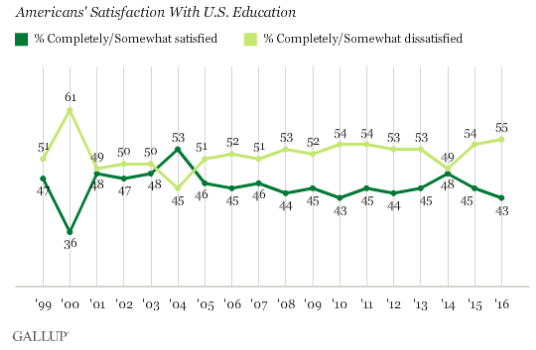
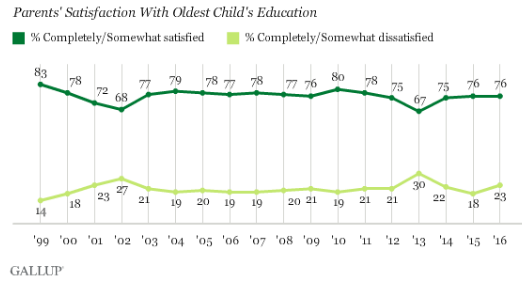
A new poll from the Gallup organization shows the highest level of public dissatisfaction and the biggest split in education opinions by party affiliation in 16 years of polling. Yet more than three-fourths of parents remain satisfied with their oldest child’s education.


Parents, who have first hand knowledge of their child’s school, have generally been highly satisfied with the results, with parental satisfaction dropping below 70 percent only twice since 1999.


Yet broader public response, including non-parents as well as parents, is much less favorable,  with less than 50 percent of all respondents satisfied with U.S. education every year except 2004. This year, overall satisfaction with education fell to 43 percent, the lowest level since 2010.


Other surveys find similar differences: parents rate schools higher than the general public, and people rate their own community schools higher than schools nationally.


The survey does not distinguish between attitudes about public schools versus other forms of schooling. Support materials released by Gallup show that over time, between 80 and 85 percent of respondents say their children are in public schools, around 10 percent are in private schools, and the remainder split between parochial schools and home schools.


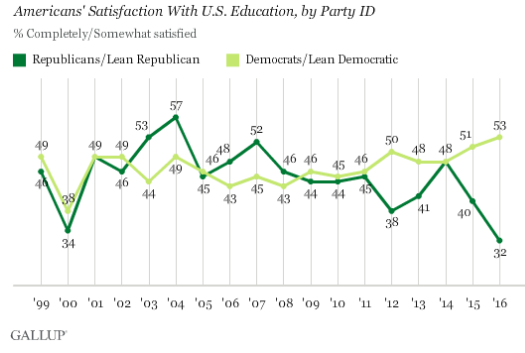
Finally, the survey shows that recent declining satisfaction with education has been largely driven by Republicans. Although attitudes by party have generally been fairly close, over the past two years satisfaction by Republicans has dropped from 48 percent to 32 percent, while satisfaction by Democrats has increased from 48 percent to 53 percent.


That means Republican satisfaction with education is at the lowest point recorded, while Democrat satisfaction is tied for second-highest. As with so many other social issues, this survey shows a deep partisan divide as the country prepares for a general election.


How might these attitudes affect public policies for education in a heavily Republican state like Kansas? Republicans at the national level and some legislative leaders in Kansas have advocated giving parents more choices in education by funding private schools or public charter schools outside of local school board control. The concept, in other words, is either taking students out of what is seen as a failing system or trusting competition to improve it.


However, surveys like the new Gallup results generally show that parents - who would have to make the choice - are much more satisfied with their children’s education than the public as a whole.


At the same time, being “dissatisfied” doesn’t necessarily mean opposition to the public school system itself. Many observers of the August primary in Kansas believe that voters were “dissatisfied” with K-12 funding levels or other state policies, not local school programs and policies - and that led to the defeat of a number of incumbent Republicans who supported those state policies.


Here are KASB reports on the Republican and Democratic party platforms for education adopted their national conventions this summer.

Tuesday, August 9, 2016

State education aid up 8% under Governor Brownback?

In a recent television interview, Gov. Sam Brownback expressed frustration that many Kansas voters seem to believe state school funding had been cut, when in fact, the governor said, funding has risen 8 percent.

To check the governor’s statement and explore why school supporters (and the public) may believe school funding has been cut, KASB used data from the governor’s budget reports, including the latest “Comparison Report” showing the final action of the 2016 Legislature for Fiscal Year 2016, which ended June 20, and the current Fiscal Year 2017.

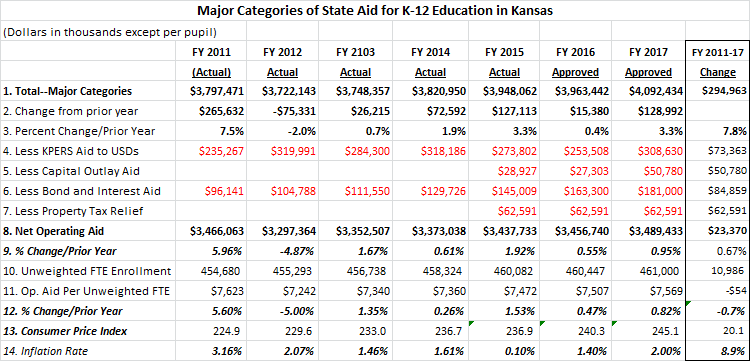
As the table below shows, line 1, the total of major state aid categories, increased from nearly $3.8 billion in 2011, the first year of Brownback’s administration, to $4.09 billion approved for next year: $295 million or 7.8 percent. That’s very close to the governor’s 8 percent number.


However, note on line 14 that the inflation rate, based on the consumer price index shown on line 13, increased by 8.9 percent  (using the Kansas consensus revenue estimate for inflation in FY 2017). Therefore, an 8 percent increase did not even keep up with the general inflation rate.

More importantly from a school operating viewpoint, lines 3 through 7 show state aid programs that cannot be used for general operating expenditures. These include KPERS aid to school districts, which increased $73.4 million between 2011 and 2017; capital outlay state aid, which increased $50.8 million; bond and interest state aid, which increased $84.9 million; and a portion of local option budget state which districts had to use for property tax relief because the LOB was capped ($62 milion).

When these funds are subtracted, state aid available for actual operating expenses, such as teacher salaries and benefits, utilities and student services, increased $23.4 million, or less than 1 percent, compared to an inflation rate of nearly 9 percent during Governor Brownback’s administration.

When net operating aid is divided by the unweighted enrollment (line 10), the amount per pupil (line 11) actually fell by 0.7 percent.

Brownback is correct that total state aid has increased by about 8 percent under his watch, but - as he seemed to acknowledged in the same interview - most of that increase went to programs that cannot be used for regular school district operating costs.

As a result, state operating aid has fallen far behind the rate of inflation, which means school districts have had to cut programs, positions or salaries in order to keep with fixed costs and rising enrollment. That explains why school leaders, patrons and other voters perceive that education funding has been cut.

Thursday, July 14, 2016

New report shows shift to college jobs and earnings; Kansas schools respond

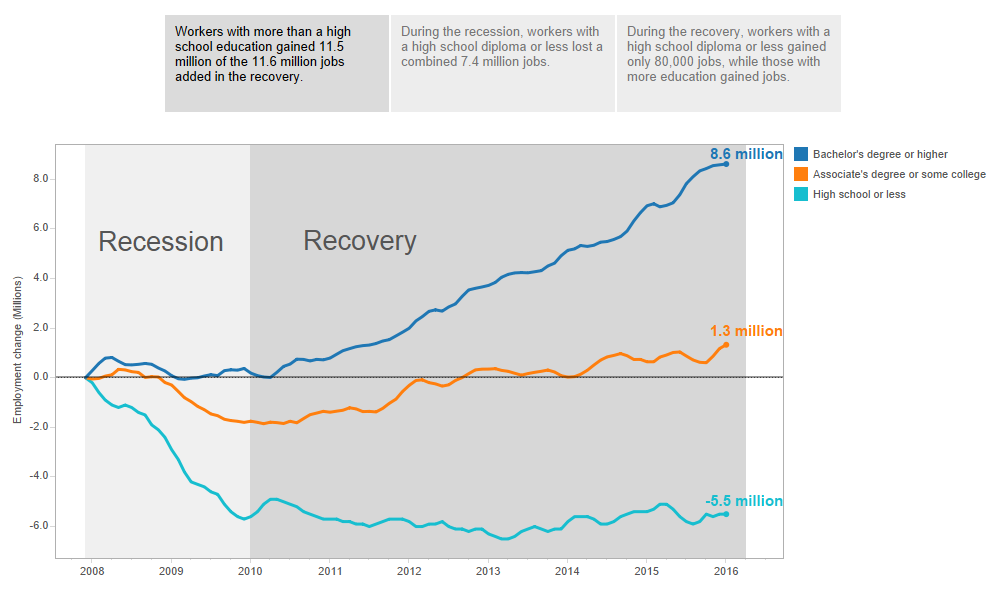
A new national report from the Georgetown University Center on Education and the Workforce (Georgetown Center) found that 99 percent of job growth in the United States since the Great Recession has gone to workers with at least some postsecondary education.


Kansas Education Commissioner Dr. Randy Watson told the State Board of Education this week the study underscores the importance boosting both high school graduation and college participation, two outcomes of the board’s “Kansans Can” initiative.

The report, “America’s Divided Recovery: College Haves and Have-Nots,” says that out of the 11.6 million jobs created in the post-recession economy, 11.5 million went to workers with more than a high school education and 8.4 million went to workers with a bachelor’s degree or higher, while employment of workers with a high school diploma or less only grew by 80,000 jobs in the recovery.


Story 1.png

“The modern economy continues to leave Americans without a college education behind,” said Anthony P. Carnevale, director of the Georgetown Center and lead author of the report. In the report, “college” refers to any postsecondary education, including technical certificates and two-year associate’s degree.

Kansas Association of School Boards spokesperson Mark Tallman says Kansas schools have been responding to this trend. “According to the most recent data from the U.S. Census Bureau, 60.1 percent of Kansans aged 18-24 have some college education, including any postsecondary hours, a technical education certificate, an associate’s degree or higher; up from 51.9 percent in 2005. In 2014 Kansas ranked seventh in the nation in percentage of 18-24-year-olds participating in postsecondary education.”

The percent of 18-24-year-old Kansans who have completed a four year degree rose from 9.7 percent in 2005 to 10.3 percent in 2014. “Keep in mind that only about one-third of Kansans in that six-year age group - those who are 23 and 24 years old - could earn a four-year degree within that time period,” said Tallman. “This means the percent of Kansas who could have earned a four-year degree and did so within six years of graduation rose from about 29 percent to over 34 percent. Kansas ranked 19th nationally in the percent of 18-24-year-olds with a four-year degree.”

However, even with these improvements, Tallman says Kansas will still struggle to meet previous projections from the Georgetown Center, which said by 2020 about 71 percent of Kansas jobs will require some training beyond high school and 35 percent will require a four-year degree or higher.

Improving the rates of high school graduation and postsecondary participation and completion has been a key focus of the Kansas State Board of Education’s “Kansans Can” initiative. A second focus has been working with each student to develop an individual plan of study based on career interests.


Commissioner Randy Watson noted that the Kansas State Board of Education was already deeply engaged in increasing the percent of students with some type of post secondary credential. “The State Board of Education vision for education - ‘Kansas Will Lead the World in the Success of Each Student’, drives their belief that all students should be moving toward completing some type of education beyond high school.”


The recession and recovery have hastened a long-term change in the composition of the American workforce. In 2016, for the first time, workers with a bachelor’s degree or higher are a larger proportion of the workforce (36 percent) than those with a high school diploma or less (34 percent). Workers with more than a high school diploma but less than a bachelor’s degree, who are typically employed in middle-skill occupations, comprise the remaining 30 percent of the workforce.


Nationally, the report found that workers with at least some postsecondary education now make up 65 percent of the total employment, and works with a four-year degree now earn 57 percent of all wages.


KASB research of U.S. Census Bureau data shows that 64 percent of Kansans over age 24 have some postsecondary education, but earn 73 percent of wages; and 32 percent of Kansans over 24 have a four-year degree and earn 44 percent of all wages in the state.

Occupational and industry shifts have been major drivers of change in the labor market. Production industries, such as manufacturing, construction and natural resources, shifted from employing nearly half of the workforce in 1947 to only 19 percent in 2016. On the other hand, industries that employ managerial and professional workers such as healthcare, business, financial, education and government services accounted for 28 percent of the workforce in 1947 and have grown to encompass 46 percent of the workforce today.

The largest occupational group in the American economy, routine office and administrative support jobs, lost 1.4 million jobs during the recession and recovery, primarily because of automation and the rise in digital information storage. These occupations were a primary source of jobs for workers with a high school diploma or less, in many cases, so the decline of these jobs has hit less-educated workers particularly hard.


Other key report findings include the following.


  • In the recovery, graduate degree holders gained 3.8 million jobs, bachelor's degree holders gained 4.6 million jobs, and Associate’s degree holders (and those with some college education) gained over 3 million jobs, compared to workers with a high school diploma or less, who added only 80,000 jobs.


  • About 5.8 million high-skill jobs in the recovery are going to workers with a B.A. or higher, whereas low skill jobs are the only area of growth for workers with a high school diploma or less.


  • Among industries, consulting and business services added the largest number of jobs in the recovery (2.5 million), while manufacturing added the second most (1.7 million). Manufacturing, however, still has 1 million fewer jobs than it did before the recession began. Construction added 834,000 jobs during recovery, but is still 1.6 million jobs short of its pre-recession employment — the largest gap among all industries.


  • Management added the largest number of jobs of any occupation since the recession began (1.6 million), while healthcare professional and technical occupations added the second most jobs (1.5 million).

“While it’s reassuring to see the economy back on track, we can’t ignore this tale of two countries with vastly different economic realities for those with and without a college education,” said Tamara Jayasundera, senior economist at the Georgetown Center and co-author of the report. “Fewer pathways to the middle class for those with less education will continue to reshape the labor market and American culture as we know it.”

The full report, “America’s Divided Recovery: College Haves and Have-Nots,” can be accessed at: https://cew.georgetown.edu/cew-reports/americas-divided-recovery/