Monday, October 17, 2016

Key Facts: How much does Kansas provide per pupil for K-12 education?

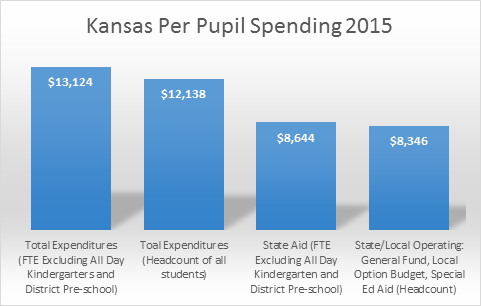
According to the Kansas State Department of Education website, Kansas school districts spent $13,124 per “full-time equivalent” pupil in school year 2014-15. This number includes all state and federal funds, all local revenues, all retirement costs and all student fee revenue, including student meals, books and other costs. This is the state average; individual districts may be higher or lower.


However, that number counts all kindergartners as half-time students, even though most kindergartners attend full-time. It also does not count more than 5,000 students in preschool programs funded by school districts. Using headcount enrollment, which counts all of these students, per pupil spending drops to $12,138.


If looking only at state aid (which would not include federal funding, local property tax revenue or income from student fees, but does DOES include KPERS retirement contributions), per pupil spending was $8,644 - using the FTE enrollment that does not count all day kindergarten students and district paid pre-schoolers. If looking only at state and local operating funds (district general fund, local option budget and special education aid, but NOT KPERS, building and equipment costs, federal programs, meals and student fees), per pupil spending is $8,346.


Follow-up: Some report lower numbers for Kansas spending per pupil. Why the difference?


As noted above, some comparisons use only state funding, or state and federal funding but not local revenues. Some may only use funding for operational costs and exclude spending on buildings and debt service. Some may exclude state contributions for the Kansas Public Employees Retirement System because these dollars cannot be used for school operations. Finally, some comparisons use only the base state aid per pupil amount from previous funding system, which was $3,852.


As a result, the “correct” answer about spending per pupil depends on what you really want to know, and why. For example, suppose an individual is seeking a loan and is asked “what is your annual income?” The individual will usually give their “take home pay.” That answer would probably not include fringe benefits and deductions for insurance and contributions for retirement, whether paid by the employee or the employer; and it certainly wouldn’t include the employer’s share of payroll for things like social security and unemployment. However, it’s the “right” answer for a lender who wants to know how much income the individual really has available to repay a loan, even though the employer is actually “spending” more than the employee takes home from a paycheck.

Likewise, in a local school district budget, much of the revenue is not available for regular educational operating costs, even if is being spent on other important costs.

Friday, October 14, 2016

Key Facts: How do Kansas education results compare to other states?

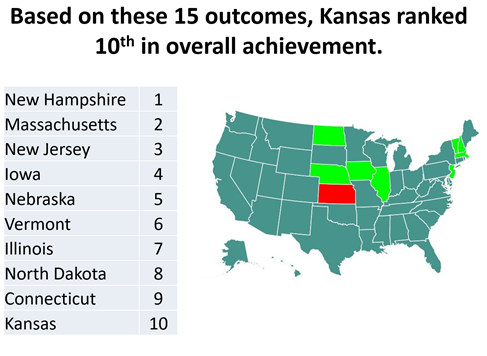
When considering multiple measures (test scores, graduation rates, postsecondary participation), Kansas ranks among the top states - 10th on the most recent report from KASB. Kansas ranks higher than the U.S. average, neighboring states, and states most like Kansas demographically.


These results give Kansas students an advantage because higher education levels have higher average pay and employment rates, and more jobs in the future will require higher educational credentials.


However, on most of these measures, other states have been improving faster than Kansas in recent years, which means more states could begin to pass Kansas in achievement.


Follow-up: Some say Kansas performs only about average on national measures. Is that true?

It depends on the specific test or other measure. Like all states, Kansas does better on certain tests or with specific groups, and worse on others. That is why KASB uses an average of various tests, measures and groups of students, rather than any single indicator.

Thursday, October 13, 2016

Key Facts: What are current Kansas education achievement levels?

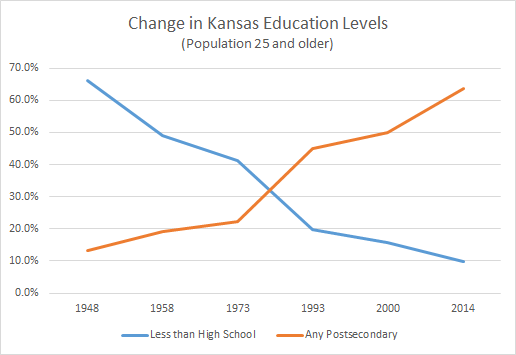
Overall education levels in Kansas are at an all-time high. This includes the percent of population that has completed high school, any level of postsecondary education, or completed a four-year or advanced degree.


More young Kansans (18-24 years old) are completing high school, beginning college and completing degrees than ever before.


However, as has been true in the past, students from low-income families, students with disabilities and students learning English as a second language continue to lag behind other students.

Follow-up: Some say a majority of Kansas students are “failing” or “not proficient” or “not college ready.” Is that true?

When test results show a majority of Kansas students are below a benchmark, they are referring to a high performance level generally aimed at college level-preparation. In the past, most students did not need to reach these levels because students did not need or expect to complete a four-year degree or more. It’s not that more students are failing; it’s that standards have been raised.

Friday, September 23, 2016

What does Kansas student achievement say about school funding adequacy?

During oral arguments before the Kansas Supreme Court, the State of Kansas argued that current school funding is constitutionally suitable because Kansas students and schools do so well - and cited research from the Kansas Association of School Boards.

The plaintiffs - representing school districts - argued funding is NOT suitable because many Kansas students do so poorly - citing evidence often presented by critics of public schools.

The state’s argument that Kansas schools are doing “well enough” makes sense if you are satisfied with our current results, because current funding is obviously producing current outcomes. There are at least four reasons to NOT be satisfied, however.

First, the Kansas Constitution, Article Six, Section One, directs the Legislature to provide for educational IMPROVEMENT through a public school system, even if results are good or better than the past; and to make “suitable provision for funding” that system.

Second, the State Board of Education, which is constitutionally responsible for “general supervision” of public schools, has called for leading the world in the success of each student, including higher graduation rates and postsecondary participation.

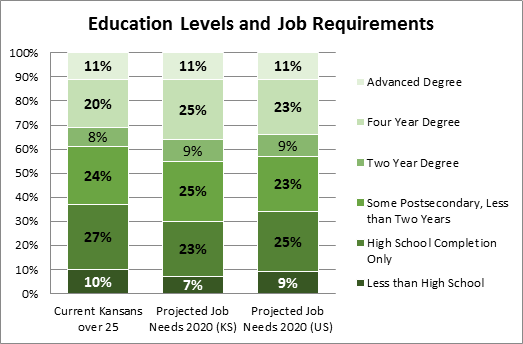
Third, new reports from the Georgetown Center on Education and the Workforce say Kansas students will need higher levels of education to be successful in the future job market, confirming the State Board’s vision.

Fourth, low income, minority and students with disabilities are much less likely to score at satisfactory levels on standardized tests, to graduate high school or complete postsecondary programs - and these students are the fastest growing segments of the state population.

KASB’s latest (2016) report card research shows that Kansas ranks tenth when measured by multiple factors, including national reading and math scores, graduation rates for various student groups, college readiness tests (ACT and SAT) and educational attainment by young adults.

However, the same data shows that although Kansas does better than most states, around 15 percent of students do not graduate high school, that educational achievement isn’t matching future jobs needs, and there are major differences between upper income and economically disadvantaged students.

For the current constitutional debate, the question is whether additional funding is required to improve on this record.

When the state’s attorney cited KASB research about the high ranking of Kansas schools, he didn’t mention that ALL of the states that rank above Kansas provide more total funding per pupil than Kansas. While there are a number of states that spend MORE than Kansas and have LOWER results, no state in the country spends LESS than Kansas and gets HIGHER results.

Four of the nine higher achievement states are midwestern and Plains states like Kansas. For the most recent year data is available, Illinois spent $1,752 per student more than Kansas; Iowa $771 more, Nebraska $1,197 more and North Dakota $1,753 more (all after adjusting for regional cost differences).

The average of these four higher achieving states is $1,753 per pupil more than Kansas, or $806 million for approximately 460,000 Kansas students. That number is within the range of additional funding suggested by a three-judge panel, based on previous Legislative cost studies.

What could Kansas expect from funding that was more in line with higher achieving states?

On national reading and math tests, 36 percent of Kansans scored at the proficient level in 2015. In the nine overall highest achieving states, 42.1 percent of all students scored proficient.

Kansas had an “on-time” graduation rate of 85.7 percent for all students, compared to 87.9 percent in the top nine states.

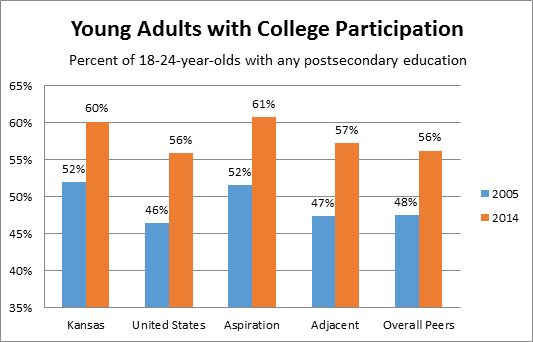
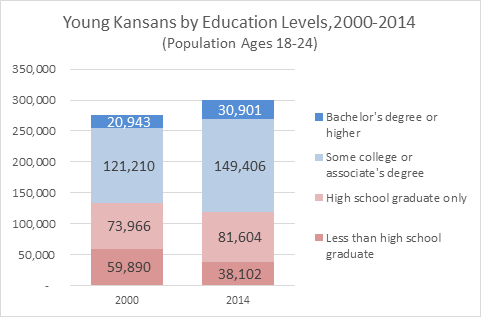
Among 18-24-year-olds (young adults recently out of the K-12 system), 60.1 percent of Kansans had some postsecondary education but less than a four year degree, compared to 60.8 percent in the top nine states; and 10.3 percent of 18-24-year-old Kansans have completed a four-year degree or higher, compared to 13.0 percent in the top nine states.

The difference between Kansas and the top states may not seem like very much. The fact is, Kansas is already fairly close to the top states in achievement, even though total Kansas funding per pupil is 29th in the county. That seems to be a strong indicator that Kansas school boards are using funds both effectively and efficiently; and would improve results if funding increased.

But what if Kansas improved education attainment by just 3 percent at each level: moving 3 percent from non-graduates to completing high school; 3 percent from high school graduates only to attaining a one- or two-year degree or technical credential; 3 percent from those less than four years of college to completing four years or more? Based on 2014 data, the additional average annual earnings for those who moved up a level would increase over $26 million for each class of students, or over $1 billion for an average 40 year working career.

Not only would this increased earning power boost the entire state economy, it would almost certainly reduce unemployment, social services and criminal justice costs.

The state argues FUNDING is adequate because Kansas education OUTCOMES are adequate: better than most states, improving over time, and other states have the same gaps in performance as Kansas.

The plaintiffs argue that despite these facts, too many students are not where they need to be on test results, graduation and college attainment; and that it will take more resources to do better.

KASB’s report card research, based on national data sources, supports the state’s claim that Kansas schools on average are performing well, but also supports the plaintiff’s claim that current funding levels are leaving many students behind.

But the state did not to mention the report card data provides strong evidence improving those student outcomes will require increased funding, and that improved outcomes will pay off in greater student success and increased future earnings.

Monday, September 19, 2016

What would Kansas schools do with more money?

If the Kansas Supreme Court orders the state to raise school funding by several hundred million dollars, what would local school boards do with that money?


Keep in mind three things. First, about 66 percent of total school district spending goes to salaries and benefits for school employees and another 14 percent goes to contracts for services provided by employees of the contractor. In other words, most school funding goes to people. If districts receive more money, they will spend it on people. That’s what happened when schools received a court-ordered increase in 2006 through 2009 following the Montoy school finance decision.


Second, Montoy funding was reduced following the Great Recession of 2008. Since then, total school funding in Kansas has barely kept up with inflation and operating budgets - which exclude retirement contributions and costs of new buildings - have fallen behind inflation. In addition, there are more students to educate, and more students with special needs. So, for eight years, school districts have not had ANY “extra” money to improve programs.


Third, the Kansas State Board of Education’s “Kansans Can” vision has set new goals for K-12 education. Comments from school leaders across the state make clear local school boards will have the following priorities for additional funding.


Early Childhood. Because many students start school far behind their peers and some never catch up, giving more attention to the youngest students helps “level the playing field.” After the Montoy decision, the percentage of districts providing all-day kindergarten increased from about 50 percent to 95 percent.


However, the State Board has set a goal of getting more students ready for kindergarten. Districts now provide preschool programs to about 5,000 students statewide, compared to a kindergarten class of 37,000. More funding would allow districts to offer free preschool for thousands more low income students.


Individual plans of study for career preparation. Last year, districts employed 1,110 school counselors, less than one for every 400 students. To help students and families decide what classes and programs match their interests and leave high school better prepared for college or the workforce, the State Board has made individual career planning a Kansans Can priority.


More funding would allow high schools and middle schools to add more career and academic counselors and continue to help students with social and emotional issues (another Kansans Can outcome). Thirty-three states have a lower student to counselor ratio than Kansas and private schools have much lower ratios than public schools, according to national data.


Graduation rates. Although Kansas performs better than most states, low income, disabled, and English Language Learners continue to lag behind in high school graduation, which is a requirement for postsecondary education (and most jobs). To meet the Kansans Can goal of higher graduation rates and more Kansas students prepared for higher skill (and higher paying) jobs, districts must provide extra support for these students.


More funding would allow districts to address the intensive needs of students with physical and emotional disabilities, help students learn English faster, provide additional tutoring and enrichment before and after school and during the summer, and assist low income and first generation college students in preparing for more rigorous college programs and testing.


School districts did all of these things after the Montoy funding increase, but have had to cut back on these services as funding fell back.


Technical Education. Experts predict 71 percent of Kansas jobs in the year 2020 will require education beyond high school, and many will require a technical certificate rather than an academic degree. Offering these programs in high schools lets students get a lower cost head start on a well-paying career, but such courses tend to be expensive because of specialized equipment and lower pupil-teacher ratios.


More funding would allow school districts to expand student options for career paths, especially in more rural parts of the state; strengthening the state and regional work forces.


Teacher salaries and learning time. Since 2008, Kansas teacher salaries have slipped from 37th to 41st in the nation. With limited dollars for raises, many school boards and teachers have negotiated for fewer school days, but also added more minutes in each day. On average, students have lost a full week of days from the school calendar.


More funding would make Kansas teacher salaries more competitive with other states and, in exchange, allow districts to add back days for student learning - which would support all of the Kansans Can outcomes.


Costs to parents and property-taxpayers. Because state operating aid has been so limited, districts have been raising fees and adopting new charges to make up the difference, and have increased local option budgets, which are primarily funded by local property taxes.


The result is a higher burden on low-income students and low-wealth communities. More funding would allow districts to rely more on general revenues rather than on those who can least afford it.


Kansans “can” expect these results if more money is provided to public schools, whether by the Supreme Court or otherwise.