Tuesday, April 29, 2014

What does the new school finance law mean for school budgets next year?

(Updated April 30 to include new inflation estimates.)

Total state aid to school districts will increase by $173 million next year, or 5.3% over the current year under the bill signed by Governor Brownback last week.  However, school operating budgets - the funds available for "classroom" costs such as teacher salaries, staff positions and utilities but exclude pension payments and capital expenditures - are expected to increase 1.5%, and just 1.3% on the per pupil basis.


That means the regular operating funding per pupil will increase, but probably not as much as the rate of which inflation, was projected to be 2.1% next year in the most recent state revenue estimates.  Total funding per pupil, which includes capital costs (building and equipment) and state pension contributions, is projected to be an increase of 2.4%, but more than half of the total increase cannot be used for regular operating expenditures.


These projections reflect statewide totals.  Individual district budgets will differ significantly for reasons explained below.  Overall growth that is less than inflation and actual funding reductions in some districts is why many districts are already considering potential budget and personnel cuts and even though statewide total funding will increase.


These estimates were developed by KASB based on the previous estimates developed by the Kansas State Department of Education, the Division of Budget and the Legislative Research Department, revised by the appropriations provided in HB 2506 and new projections from these state agencies.


It is important to stress that these are only estimates.  The actual increase in funding will be determined by how much additional local option budget authority local school boards decide to use, changes in local capital outlay use and payments on school construction bonds, and other local revenues not budgeted at the state level.  Actual per pupil spending will depend on actual enrollment, which will not be known until next year.


Here is a summary of what KASB expects, based on the school finance bill.
General Funds Budgets.  The foundation of the school finance system is the district general fund budget, determined by multiplying the base budget per pupil by adjusted, or weighted, enrollment.  The base budget per pupil will increase by $14, to $3,852, or 0.4%.  HB 2506 reduced district at-risk weighting in several areas to cut state funding by $8.2 million.  At the same time, both regular and weighted enrollments are projected to increase, which means total general fund budgets will increase by $13.3 million, or 0.5%.  Some districts will lose more because of cuts in at-risk weightings, while other districts will get a bigger increase because of higher enrollment growth.
Special Education Aid. State special education aid will increase slightly (0.01%) to meet estimated federal maintenance of effort requirements.
Local Option Budgets.  One of the most complicated aspects of the new bill concerns the local option budget.  The State Department of Education estimates that actual LOB revenues - what districts can spend - will increase by $46 million.  Here is how the $46 million estimated increase was developed:


  • First, the maximum LOB a district can adopt is controlled by the state. Under current law, the maximum was 31% of the district’s general fund budget plus special education state aid.  Any amount over 30% required approval by district voters.


Not all districts are currently at the maximum.  One reason is that the LOB is funded in two ways: local property taxes plus state aid for approximately 81% of districts, based on local property tax wealth per pupil.  (The wealthiest 19% of districts in valuation per pupil do not receive state aid.)  Because the state has not been fully funded the LOB state aid formula, lower wealth districts had to rely more heavily on local property taxes, which created pressure to hold down the LOB and keep mill levies in check.


Keep in mind that lower wealth districts require much higher property tax rates to raise the same amount of money as wealthy districts. That was the basis of the Supreme Court’s Gannon ruling on school finance equity.  It said the state must either fully fund LOB aid or take other action to correct the “wealth-based disparities” in the LOB.  KSDE indicates that fully funding LOB state aid will increase the percentage of statewide LOB authority districts would use. In other words, districts cut back on LOB use because the state wasn’t paying its share; if state aid was fully funded, districts would use more LOB because the property tax cost would be lower.


  • Second, the LOB system is further complicated by the fact that since 2010, the Legislature has allowed the district’s general fund budget to be calculated for determining the LOB as if the base budget per pupil was $4,433 (the amount districts used to adopt their budgets in 2008-09), rather than actual base, which was reduced to $4,012 in 2009-10; $3,937 in 2010-11 and $3,780 in 2011-12.  (It was increased to $3,838 last year and remained the same for the current year.)  Without the artificial base, districts at or near the maximum percentage would have been required cut their LOB.


HB 2506 increased the actual base to $3,852 next year, an increase of $14. However, the bill also increases the artificial LOB base from $4,433 to $4,490, for the next two years only.  This essentially means that districts can raise more money through their LOB without raising the percentage, because the same percentage applied to a large (artificial) base is a higher number.  However, this increase is temporary.


  • Third, HB 2506 changes state law to take the enrollment of students counted in virtual education programs out of the budget for determining the LOB amount.  For example, if a district had 95% of its enrollment in regular “bricks and mortar” programs and 5% in on-line programs, it can now only apply its LOB percentage to the 95% of students in non-virtual programs.  This will a major impact on districts with large virtual enrollment.


The impact of these changes means that districts statewide are expected to increase LOB revenue; i.e. the total they can spend, by $36 million.  That assumes use of 74% of the new revenue available.  However, some districts are projected to have less LOB revenue - in other words, a cut in dollars available - primarily because of the change in virtual weighting.


  • A fourth change in the LOB law increases the maximum LOB amount from 31% to 33%.  Any LOB level above 30% will continue to require voter approval in an election, but the new law requires that future LOB elections must be conducted by mail ballot.  However, in a twist, districts that have already adopted an LOB above 30% by July 1 can adopt an additional 2% for next year without an election - but must submit the additional amount to voters for the following year.  KSDE expect these districts to increase their LOB’s by about $10 million next year.


The $36 million LOB increase due to the higher artificial base and other changes, added to the $10 million LOB increase for districts already over 30%, equals the projected $46 million higher LOB spending next year.  However, in order to fully fund the LOB aid formula, state LOB aid will increase about $110 million.  Approximately $14 million will be required to “equalize” the additional LOB spending.  The difference will be property tax reduction.  In other words, because a district’s LOB is capped by the state, if state aid increases more than the LOB amount goes up, it automatically reduces the district’s LOB property tax.


Three things are important to stress.  


  • First, the impact on individual districts will differ significantly.  Some districts will receive NO additional state aid because they are higher wealth districts.  Any increase in LOB will require a higher local mill levy. Other districts will be able to raise the LOB amount and still reduce their mill levy.  Still others may choose to keep the LOB at the same level and use all new state aid to reduce property taxes.  The decision will be made by the local school board.


  • Second, these are estimates.  Districts could end up using more of the new LOB authority - or less in order to hold down property taxes.


  • Third, note that a big portion of the new LOB funding may be temporary.  The artificial base will drop from $4,490 to $4,433 in two years, and completely expires after three years unless the Legislature extends it. The estimated $10 million LOB increase for districts already above 30% could be rejected by voters next year.


Federal Aid.  KASB includes federal aid at this point because some of these funds are available for current operating costs, such as teacher salaries.  Federal aid is expected to increase $8 million next year (1.8%), with $5 million for increased free and reduced price meal payments for low income students, and $3 million for special education, Title I programs for disadvantaged students, career technical education and other programs for students and teachers.


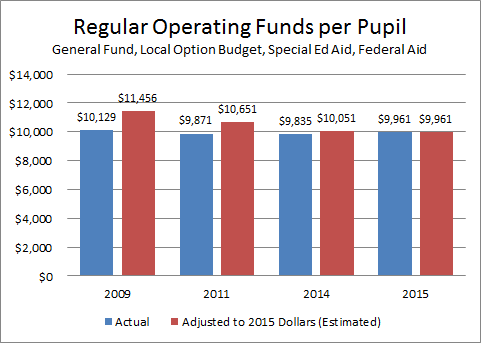
Total Operating Expenditures.  These four budget areas (general fund, state special education aid, local option budgets and federal aid) represent almost all of the funding school districts can use for current expenditures like salaries, operations and maintenance.  KASB estimates the statewide total next year at $4.58 billion, an increase of $67.9 million over the current year, or 1.5%.  On a per pupil basis, using full time equivalent enrollment, funding is expected to increase from $9,835 to $9,961, or 1.3%.


This level would be $90, or 0.9%, higher than 2011, the first year of Governor Brownback’s administration, and $168, or 1.7%, lower than 2009, the highest level of funding before budget cuts began as a result of the Great Recession.  The inflation rate, measured by the consumer price index, is projected to be nearly 8% higher than in 2011 and 13% higher than in 2009.


Capital Aid.  Other parts of school district budgets have increased much more than operating expenditures.  To comply with the Gannon decision, HB 2506 also includes $25.2 million to fully fund the capital outlay state aid program, which has not been funded since 2010.  These funds are restricted to long-term expenditures, such as building construction, repair and remodeling, and equipment.  The new law also expands use to performance uniforms and computer software.  It is also possible that some districts will be able to use additional capital outlay aid to reduce transfers from other funds and free up money for general operating costs.


In addition, the bill provides $7 million more for bond and interest state aid.  Both capital outlay and bond and interest aid are provided to districts with lower wealth per pupil to help finance capital costs without requiring disproportionately higher mill levies for these purposes.


In 2009, capital outlay aid was $22.3 million and bond and interest aid was $75.6 million.  Next year, funding will be $25.2 million and $135 million - an increase of over 60% in these programs combined since 2009.


KPERS Funding.  Another area of significant growth has been contributions for school district employees’ pensions under the Kansas Public Employees Retirement System.  The contribution is based on a percentage of school district payroll for covered employees.  Because the KPERS system is significantly underfunded, the Legislature has been increasing the percentage.  Next year, the KPERS appropriation for school employees - which also includes employees of community and technical colleges - will increase by $37.2 million, or 10.3%, to $398 million.  This amount has increased nearly 65% since 2009.  Approximately 91% of the KPERS school appropriation goes to school districts and is included in district budgets.


All other revenues.  The remainder of school district budgets are raised from local revenues, such as school district bond payments, local capital outlay revenues, and student fee for meals, books, activities and transportation.  Because these funds are not budgeted at the state level, it is difficult to provide an accurate estimate, but for this purpose, KASB is assuming these revenues will increase 2% next year, based on comparable increases in recent years.


Total expenditures per pupil. Based on appropriations for capital outlay, bond and interest and KPERS funding and a 2% increase in all other revenues added to the total operating funds estimated above, KASB estimates that total school districts expenditures will increase $153.4 million, or 2.6%, next year, which would be 2.4% per pupil.  This would be just slightly higher than the inflation rate projected last fall by state budget experts.  However, it is important to note that less than half of that amount is for regular operating expenditures that make up 75% of district budgets statewide.
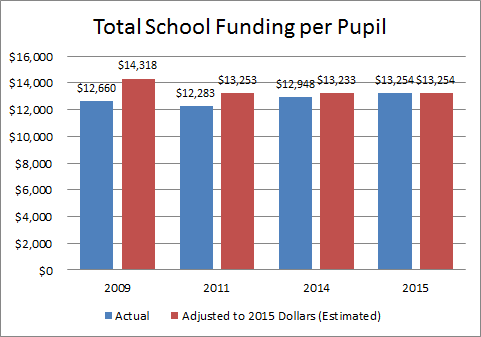


This would result in a total expenditure per pupil of $13,254, up from an estimated $12,948 in the current year.   The 2015 estimate would be 4.7% higher than 2009, an increase of less than half the rate of inflation.  (The consumer price index is projected to have increased 13.1% between 2009 and 2015.) The actual total expenditure per pupil will not be known until next fall when school district budgets are reported to the state.

Friday, April 18, 2014

What do higher state revenue estimates really mean?

Yesterday, a group of state budget and tax experts and university economists released the official consensus revenue estimates for the current budget year ending June 30, 2014 (Fiscal Year 2014) and next year (FY 2015).
The new April estimates update projections made last November.  The report says receipts to the state general fund will be $105.6 million more in the current year and $74.3 million more next year than projected in November, or an average of about 1.5 percent per year.  However, that simply means that revenues will be 1.5 percent per year higher than previously expected - not that state revenues are actually growing at that rate.
Total state general fund revenues are now projected to be $5.96 billion this year, which is 6 percent less than last year ($6.34 billion).  The loss is due to a 14 percent drop in state individual income tax revenue from the rate cuts approved by the Legislature and the Governor.  Total SGF revenues next year are projected to be $5.99 billion, or 0.5 percent more than the current year.  Individual income tax revenue is not projected to increase at all next year. Total taxes receipts - which exclude transfers and other adjustments to the state general fund - are expected to increase 1.3 percent from the current year to next year.
A much more detailed report from the consensus revenue estimating group will be released next week, and will include new projections for state economic activity.  For now, the new estimates suggest the state economy is growing slowly: less than would be hoped after the significant tax cuts passed two years ago to stimulate the economic growth.  However, revenue growth is also projected higher than expected five months ago.
That means the state general fund should be better able to absorb the cost of the school finance bill passed earlier this month and waiting for Governor Brownback’s signature (or veto).  The school funding bill adds about $130 million for school district state aid next year beyond increased funding already approved by the Legislature and proposed by the Governor.  The new revenue estimates were increased by $178 million over two years. The Legislature has not passed appropriations bills for state programs other than K-12 and higher education.
The new estimates only consider the current fiscal year and next year (FY 2015).  Previously projections indicated the state would likely face a budget deficit in future years if state revenues do not increase at more than normal historical rates, because of future income tax rate reductions already locked in place and projected increases in mandatory spending such as health care caseloads and pension costs.
The Senate Ways and Means Committee will meet Tuesday, April 22 at 10:00 a.m. to review the consensus revenue estimates and other budget issues.  The House Appropriations Committee is scheduled to meet Wednesday, April 30, to review the consensus revenue estimates and take action on appropriations bills for bill state agencies.

Here is a link to the consensus revenue estimate “short” memo that will be expanded next week, and a new story about competing political views on the new estimates.

Thursday, March 27, 2014

Impact of New Senate Republican School Finance Proposals

Two approaches to addressing the Gannon school finance decision were presented at the Republican Senate Caucus Wednesday.  Both would finance the nearly $130 million estimated cost of fully funding the Local Option Budget and Capital Outlay state aid in part by making significant cuts in other school funding areas.  Both would also increase the maximum LOB authority for districts.  The net impact on individual school districts would vary significantly.

The first proposal was offered by Senate Republican leaders.  The second was a variation offered by Senate Ways and Means Chair Ty Masterson, R-Andover.  Spreadsheets showing the impact of both plans were presented yesterday to Republican Senators, as well as a spreadsheet of the Democratic proposal to simply add $130 million without offsetting cuts.  KASB has PDF copies of the spreadsheets, but does not have actual spreadsheet files for calculations.  The Kansas State Department of Education does not plan to post spreadsheets until proposals are in bill form.

It should be stressed that all of these proposals are simply concepts and likely to change.  However, it is important to understand each of these concepts individually and how they work together. Here are some key points to remember.

  • First, the $105 million identified by the courts to address inequities in the local option budget would primarily go to “equalize” property taxes.  It would not provide ANY new spending authority.  For districts that are effectively capped at the maximum LOB, increased state would simply reduce their mill levies.  Because lower wealth districts get the most state aid, they would have the biggest decrease in mill levies.  On the other hand, the wealthiest districts would receive no additional aid.

  • Second, the $25 million capital outlay state aid would provide more spending power to districts that receive it, but can only be used for long term capital costs, not regular operating budgets.  Again, a number of higher wealth districts would not receive any of these funds.

  • Third, to reduce the cost to the state, both Senate Republicans plans (and to a lesser extent, the House Republican plan in HB 2774) cut other parts of the school district funding formula.  These means districts would lose actual operating funds.  Statewide, the Republican Leadership plan would cut operating budgets by about $36 million.

  • Fourth, these targeted cuts have very different impacts.  For example, reducing the transportation weighting (in all three plans) affects every district, but some districts transport a higher percentage of their students and would likely have a higher reduction.  Other weightings apply only to certain districts.

  • Fifth, the Senate plans - unlike the House proposal - would allow districts to increase their Local Option Budget from the current maximum of 31 to 33 percent, with an election required for percentages over 30 or 31 percent.  (An explanation memo says 31 percent, but staff sources understood the proposal to be the current threshold of 30 percent.) The Senate documents say that proposal would allow districts increase LOB authority statewide by almost $85 million.

  • Sixth, most local boards are concerned about raising their LOB because it has required a mill levy increase, which would be unpopular with voters.  However, in many districts, the amount of LOB state aid required by the Gannon decision appears to be more than the cost of increasing the LOB to 33 percent.  In other words, they could raise their LOB to cover losses in the general operating funds WITHOUT increasing the mill levy, but their taxpayers would have a smaller mill levy reduction.  On the other hand, districts that receive little or no state aid might have to raise their LOB percentage AND mill levy to make up for the loss in weightings.

The result is that both Republican plans would potentially provide additional operating funds on a statewide basis, unlike the current House plan or Democratic proposals to simply fund LOB and Capital Outlay state aid.   However, the actual impact on each individual district varies dramatically.  It’s critical for school leaders to work with their Legislators to determine the impact of each component, as well as the total net impact.  Finally, depending on any election threshold, it would be up to local board and/or voters to actually use the increased operating authority.

Now, let’s look at the specific components of each plan.  It should be stressed these are not actual bills, and are highly subject to change.

Senate Leadership proposal:

Fully fund Local Option Budget state aid.  Requires an estimated $103.9 million next year, up from $94.5 million in the current year.  The approximately 19% of districts with the highest assessed valuation per pupil do not receive LOB aid.  The remaining 81% quality for aid. As a district’s valuation per pupil declines, it received a higher percentage of aid for its LOB, which reduces the required mill levy for its LOB.  Because state aid has not been fully funding, these districts have had to either raise their mill levy or reduce the LOB.

Fully fund Capital Outlay state aid. Requires an estimated $25.2 million.  There is a similar formula for capital outlay aid, which is used match or supplement a local capital outlay levy.  Capital outlay aid has not been funded since 2010.  Only about half of districts would receive aid, either because they are high in valuation per pupil, or because they do not have a capital outlay levy.  Capital outlay cannot be used for regular operating expenditures. However, under a law passed last year, if the aid formula is fully funded, districts can use these funds for some additional purposes, such as performance uniforms and software.  Districts would have to adopt a new capital outlay resolution, subject to protest petition, to spend on these additional purposes.

Count an increase of $14 in base state aid per pupil.  Raising the base from $3,838 to $3,852 is already included in the Governor’s budget.  This will provide districts an estimated $9.6 million.

Reduce virtual school funding by over 50 percent.  This would save the state - and cost school districts - $14.4 million.  The proposal would fund students in virtual schools at 50 percent of the base budget per pupil, with no additional weightings.  Currently, students in virtual programs are funded at 105 percent of the base state aid per pupil.  This would reduce funding in over 80 districts.

Eliminate at-risk non-proficient weighting.  This would save the state - and reduce total district funding - by $4.9 million.  Non-proficient weighting is based on students who score below proficient on state reading or math tests and are NOT eligible for free meals.  (The number of students receiving free meals determines the district’s “regular” at-risk weighting.)  The weighting was designed to allow districts with very low free lunch rates to receive funding for programs assisting students who are at-risk of academic failure.  Every districts receive some funding under this weighting - and would lose by its elimination.

Reduce transportation weighting by $16.5 million.  This proposal (the same as in HB 2774) which would adopt a different formula developed by the Legislative Post Audit Division in the 2006 school district cost study.  It would reduce transportation funding for every district, and cut total transportation aid by about 16 percent.  It would reduce transportation aid for every district.

Reduce high density at-risk weighting by $7.2 million.  Approximately half of school districts would have funding reduced by this cut.  It appears the reduction would be based on a change in the “linear transition” so districts with the least density of low income students would receive the highest percentage cut.  Total high density at-risk funding is $52 million, so this would be a 14 percent reduction statewide.

Reduce eligibility for at-risk weighting by $3.5 million.  The proposal would disallow the counting of any students over 19 years old for at-risk weighting, which is contained in HB 2774, and would also disallow counting part-time students (other than kindergarten) for at-risk weighting.  KASB does not have information on who many districts this would affect.

Phase-out new facilities weighting.  The proposal would allow facilities in their second year of operation to receive this weighting, but no new facilities would be eligible next year, reducing the expected cost in 2014-15 by $10 million.  Approximately 35 districts received $13.7 million in new facilities weighting this year.

Increase the maximum Local Option Budget from 31 percent to 33 percent, with anything above 31 percent requiring an election.  Under current law, districts are required to hold an election to adopt an LOB over 30 percent of the general fund, and the maximum percentage is 31 percent.  Presumably, this proposal would allow districts at 30 percent or below to increase to 31 percent without an election, and those districts at 31 percent or below to increase up to 33 percent, if approved at an election.  However, Legislature staff indicate that the intention may have been to keep the election for LOB amounts over 30 percent.

In order to hold an election in time to authorize a higher LOB for next school year, the election would probably have to be held no later than the August primary election.  The Secretary of State’s office indicates school boards would need to notify their county election officials by the first of June.  This issue will become difficult of a bill does not pass in time to take effect prior to that date.

The plan appears to assume the amount of LOB state aid required to fully fund equalization for the additional LOB authority next year is $5 million.

The net result is that the $129 million cost of LOB and Capital Outlay next year would be reduced by $14.4 million in virtual weighting, $4.9 million in non-proficient weighting, $16.5 million in transportation weighting, $7.2 million in high density at-risk weighting, $3.5 million in at-risk weighting by not counting students 19 and older and part-time students, $10 million for new facilities weighting; and adding $5 million for increased LOB equalization due to raising the LOB maximum from 31 percent to 33 percent.  This leaves a “net” cost to the state of $77.6 million, rather than nearly $130 million.

However, the LOB spending “authority” would also increase, by about $85 million statewide.  The more districts actually used this additional LOB authority, the greater the cost of LOB equalization.  Remember, the actual impact on individual districts varies.

Senator Masterson proposal (same leadership plan with the following exceptions):

Increase base state aid per pupil $65, rather than $14, and further increase the base $450 to include funding for KPERS.  This would provide a total increase of $515 dollars to the base, at a statewide cost of $352.3 million.  Most of this would be from dividing total current state KPERS contributions for school employees by weighted enrollment and adding that amount to the base.

Require districts to pay the actual cost of the employers KPERS contribution on behalf of their employees.  This would cost districts a total of $307.5 million next year.  This means every district would receive the same amount for each weighted student in the base, but would have different costs depending on what they pay their employees.  Because the KPERS cost is based on a percentage of payroll, districts with higher employee costs would have to spend more than they received in base aid, while districts with lower costs would spend less on KPERS than they received in base aid.  In addition, because the base is increased goes to weighted enrollment, districts with more weighted students receive more.

It should be noted the KPERS contribution rate is expected to increase significantly over the next several years.  Under current law, the state is responsible for paying that increase.  Under the new proposal, if the base did not increase at least as fast as the KPERS rate, districts would have to reduce other expenditures to pay for KPERS.

Reduce regular at-risk weighting by 10 percent.  This would save the state - and reduce district funding by - $34.5 million.  It would impact every district.

Reduce high density at-risk weighting by $36.7 million, rather than $7.2 million.  This would reduce high-density at-risk funds by over 70 percent.

Provide $14 million statewide for transition funding.  This is described as a one-year “hold harmless” provision that would keep any district from a net loss in state aid.

Impact on your district:

To calculate the impact of these changes for  your district, you need to review the proposed spreadsheets (or other proposals).

First, determine any proposed additions to your general fund through the base budget.

Second, subtract the reductions in weightings and other costs, such as KPERS payments in the Masterson plan.  The result is the net change in your general fund budget.

Third, estimate the impact of fully funded LOB state aid on your LOB mill levy (if any).

Fourth, determine how much of an increase in your LOB would be needed to offset reductions in your general fund, and any additional increase up to 33%.

Fifth, determine what mill levy would be necessary to provide that amount.

Sixth, compare the net increase or decrease in LOB mill levy.

Seventh, determine if any capital outlay state aid received could be used to reduce the capital outlay levy, or reduce transfers that would free up additional dollars in your general fund.

This is obviously a constantly changing situation.  We will continue to update school finance proposals as we learn more, and as new plans are presented.